Posted on Leave a comment

Ištáwičhayazaŋ-Wí (March) 2022 Newsletter

[fusion_builder_container type=”flex” hundred_percent=”no” equal_height_columns=”no” menu_anchor=”” hide_on_mobile=”small-visibility,medium-visibility,large-visibility” class=”” id=”” background_color=”” background_image=”” background_position=”center center” background_repeat=”no-repeat” fade=”no” background_parallax=”none” parallax_speed=”0.3″ video_mp4=”” video_webm=”” video_ogv=”” video_url=”” video_aspect_ratio=”16:9″ video_loop=”yes” video_mute=”yes” overlay_color=”” video_preview_image=”” border_color=”” border_style=”solid” padding_top=”” padding_bottom=”” padding_left=”” padding_right=””][fusion_builder_row][fusion_builder_column type=”3_4″ layout=”1_1″ background_position=”left top” background_color=”” border_color=”” border_style=”solid” border_position=”all” spacing=”yes” background_image=”” background_repeat=”no-repeat” padding_top=”” padding_right=”” padding_bottom=”” padding_left=”” margin_top=”0px” margin_bottom=”0px” class=”” id=”” animation_type=”” animation_speed=”0.3″ animation_direction=”left” hide_on_mobile=”small-visibility,medium-visibility,large-visibility” center_content=”no” last=”true” min_height=”” hover_type=”none” link=”” border_sizes_top=”” border_sizes_bottom=”” border_sizes_left=”” border_sizes_right=”” first=”true”][fusion_text]


The latest news, upcoming events, and new materials from Lakota Language Consortium.

News & Recent Events

International Women’s Day

March 8th marks International Women’s Day! The Lakota Language Consortium spent the day celebrating the remarkable Indigenous women Elders, speakers, knowledge keepers, language learners, and educators we work in partnership with. 

LSI Details Coming Soon!

Since 2007 LLC has been hosting the Lakota Summer Institute. These 1 – 3 week-long classes are designed to offer a deep dive into the Lakota Language. Language events offer beginner, intermediate and advanced students time and space to practice essential skills with other language learners at their level.

This summer LSI will be held July 11 – 24, 2022. We are still working through the planning details of this event and anticipate releasing details soon.

Lakota Summer Institutes (LSI) allow Lakota people and those passionate about the language to come together to learn Lakȟótiyapi. It’s incredible to gather groups from across Lakota Country for a common purpose. Participants reconnect with peers, mentors, and friends from past Institutes, creating an ideal Lakota learning community – bound together and investing in the Lakota language.

If you have attended a Lakota Language Weekend or a Lakota Summer Institute in the past we will provide you with more details via email once we’ve finalized these details.

Hoping to attend for the first time this year?
Click Here To Sign Up For Updates

Lakȟótiya Wóglaka Po!

Learn More About the
Traditional Songs Book

After featuring the Traditional Lakota Songs Book – Eháŋk’ehaŋ Lakȟóta Olówaŋ there has been increased interest in the details of the book and its creation. We thought it was a great time to take a deeper dive into its details.

Shania Black Bear sat down and interviewed Ben Black Bear Jr. for more detail on the book’s origin and history. She also answers the questions about the original collaboration, and how we hope this project comes to life in the future.

Intern Opportunities

Native NYC Residents

Come spend a month in Bloomington, Indiana, and learn how the Language Conservancy supports Indigenous Language Communities. This internship allows you to see the operations, administrative, and material creation process up close and personal.

Benefits: This is a paid internship that provides housing, transportation, and a weekly stipend for your time.

Qualifications: Applications must be from New York State and must be from a North American Tribe and be between the ages of 18 – 24.
Contact internships@languageconservancy.org with any questions

Linguist & Computational Linguist Interns

This 4 – 6 week internship is focused on those pursuing a career in Linguistics. Those participating in the program will be given the opportunity to work with the Linguistics team at The Language Conservancy (TLC). Interns will assist linguists in daily tasks or on small projects. The internship is based in Bloomington, Indiana.

Benefits: This internship provides working experience of the day-to-day of a Linguist. Housing and transportation are provided in conjunction with this internship opportunity.

Qualifications: Applicants must be pursuing a career in Linguistics or Computational Linguistics Must be enrolled in a college program.

Submit your application online – Apply online here.

Product Spotlight

Learn, Color & Teach

You can color all 37 letters and practice writing out the letters in the Lakota alphabet! This coloring book not only walks you through each letter of the alphabet but also gives you a letter to go along with it.

Lakȟól’iyapi Oówaptaya Owíyuŋ Wówapi – Lakota Alphabet Coloring Book has 77 pages of learning and coloring. Whether you are learning the alphabet yourself or teaching someone else, this book is packed with language activities.

Don’t do this alone! This month you can pick up a copy of this coloring book and get another copy for free for a loved one in our book store using promo code:  BOGOABC.

New Lakota Dictionary 3.0 for Desktop – Available Soon!

If you’ve been a long-time subscriber you’ve seen this section in this newsletter for a long time. We are happy to share that our Linguistics team is in the final editing stages of the updated dictionary. Stay tuned to this section for updates in the coming months.

The New Lakota Dictionary for your desktop’s latest update will be available soon for Mac and PC with new entries and example sentences. This updated version builds on decades of linguistic work to create the most accurate and up-to-date dictionary possible, with 6,000 new entries and 13,000 new example sentences.

The New Lakota Dictionary was created in partnership with over 400 native speakers to ensure accuracy not only in spelling and definition but in context as well. This is an invaluable resource for Lakota learners everywhere and is easily accessible to anyone with a computer. When a user searches a word, they are presented with multiple definitions and spellings depending on the context in which the word is being used, as well as example sentences to demonstrate the word in a complete Lakota phrase. A total of 31,000-word entries and 53,000 example sentences makes the New Lakota Dictionary the most in-depth Lakota dictionary available, and an important tool in Lakota language learning and preservation.

Tókša akhé  – the LLC Team

Donate Now

Check Out The Bookstore

Facebook

Website

Twitter

Instagram

Email

Want to change how you receive these emails?
You can update your preferences or unsubscribe from this list


[/fusion_text][/fusion_builder_column][fusion_global id=”11370″][/fusion_builder_row][/fusion_builder_container]

Posted on Leave a comment

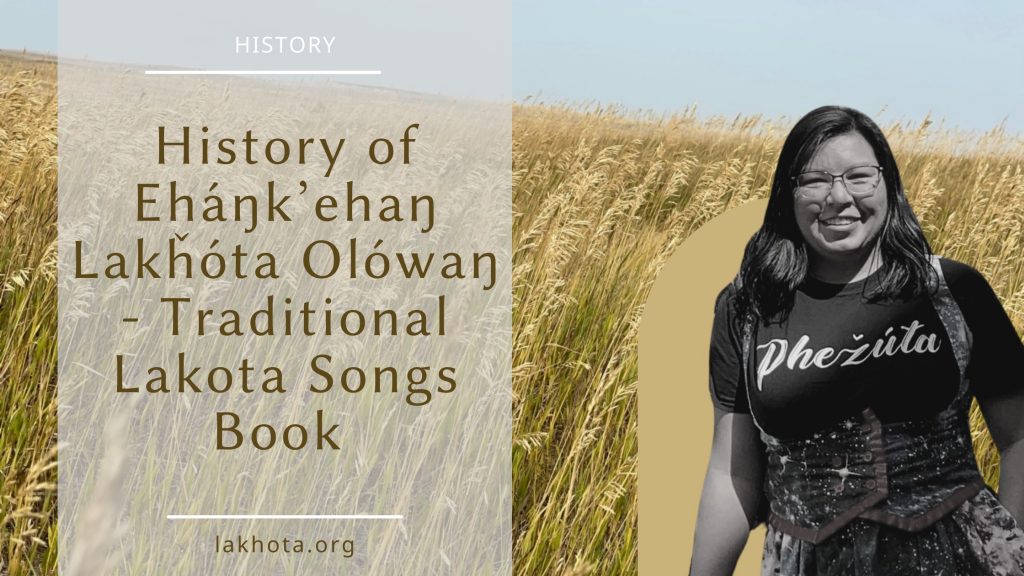
History of Eháŋk’ehaŋ Lakȟóta Olówaŋ – Traditional Lakota Songs Book

This blog post is written by Shania Black Bear-Searby about the Eháŋk’ehaŋ Lakȟóta Olówaŋ – Traditional Lakota Songs Book which can be found in the LLC bookstore.


The Traditional Lakota Songs book is a legacy that began over 50 years ago. In the summer of 1973 or 1974 Ben Black Bear Jr. and Dr. Ron Theisz began hosting a Lakota song and dance class at Sinte Gleska University (SGU) in Rosebud, South Dakota. The class was created as a demonstration of the potential of the Lakota Studies Department in the early years of Sinte Gleska University. The success of the class later resulted in the course becoming a part of the curriculum at the time, the production of the Songs and Dances of the Lakota book, as well as the Traditional Lakota Songs book. 


My name is Shania Black Bear-Searby and I am writing today about my family’s history in creating the Traditional Lakota Songs book. When gathering more information about the early Lakota Song and Dance classes provided by SGU, I spoke with an elder on Rosebud who remembered what the classes were like at that time. She recalls being a bashful young mother who was interested in the class. It was a unique experience that offered an encouraging space to learn and was welcoming to people who didn’t have access to this knowledge. She mentioned that it can be difficult to be a learner in the powwow community and that she didn’t expect the class to be as valuable as it was. The dancers who taught the dances were in their full regalia, there was a drum group singing, and everyone was encouraged to get up and participate throughout the semester. The dances were broken down into lessons that were easy to follow and she said she still holds the knowledge of the dances and songs to this day. It was a very cherished moment to not only know about the existence of this class but to hear about its success almost 50 years later. 


In the early years of the Lakota Studies Department at SGU after the summer song and dance class was successful, the instructors changed. Ben Black Bear Sr. took over instruction and Dr. Ron Theisz continued teaching. Ben Jr. outsourced local experts he grew up with and trusted including his father Ben Sr who was a traditional singer. Ben Sr created the Ironwood singers, a homegrown family drum group with his in-laws. Like many Lakota teachers, Ben Sr. opened his home to the group and taught the songs that were eventually taken on the powwow trail. The instruction of the songs and dance class worked as a living project for years being produced in audio, video, and the published book. 


The living knowledge of both the songs and the dances included in the Songs and Dances of the Lakota book was knowledge from decades before its publication in 1976. The book was worked on for several months by the main collaborators Ben Black Bear Sr. and Dr. Ron Theisz with help from various other local experts. The book exists as a bilingual text with the Lakota portions provided by Ben Sr. and transcribed by Ben Jr. Dr. Ron Theisz provided the English portions of the book. The goal of the text was to provide instruction about the various dance styles and songs that are essential parts of Lakota culture. Without these songs, it is not possible to understand Lakota culture. When collecting each type of song to include in the book there were some instances where only 1 or 2 songs were included in that specific category. Not every type of song was recorded in this book and is in no way an exhaustive list but it did produce an incredible result. 


The Iron Wood Singers collaborated with Dr. Ron Theisz and Ben Sr. to produce the audio portion that was originally recorded as reel to reel tapes then formatted for cassette tapes and later CDs. After the recording of the audio and the book in progress, the Iron Wood Singers along with a collection of dancers were gathered in the Digmann Hall in St. Francis, SD to be recorded by the video department of Sinte Gleska University. The video was completed and pictures were taken to include in the text as examples. Today, very few copies of the original audio and text exist. Our family research and outside sources have not been able to locate the video portion. We fear it has been destroyed or lost with time, either way, it remains inaccessible to reproduce.  


The reason this project came to fruition was very simple. There was a want to create materials for Lakota people to learn to sing and dance. The creators involved in the original project had two goals. First, they hoped the book would be put in the hands of teachers across the Očhéthi Šakówiŋ. The humble instruction style that was used was accessible enough that the teachers who picked it up did not need to be music teachers or dancers and could still learn the practices documented in this project. It was enough material to bring into a classroom to teach children. The dream was to have materials to teach intact Lakota culture as Lakota studies. 

Unfortunately, the materials did not appear in the classroom and mostly became a part of collections of individual buyers, much to the disappointment of the creators. 


The second goal was to inspire Lakota people to learn the songs and dances so they could be inspired and gain confidence and create music, stories, poetry, video, and other art mediums. It was intended to be a start of a process to show our people that it is possible to think, research, produce, and repeat for those involved to create any material they wanted. It was the instruction that came from the home, structured and recorded to go into schools, to again appear in the home. 


Reflecting back on this process that existed around 50 years ago it is amazing that this project came to fruition and produced materials against all odds. At the time they were producing this product from scratch and there were very few materials available to base things off of. We sometimes find ourselves in similar situations in smaller communities feeling the need to create structure by researching, creating materials, and developing lesson plans. They did this with little to nothing at the time and pondered if this was right or what their efforts would result in. They took leaps of faith and went with the steps that seemed logical and ran. The incredible moves of the early Language movement efforts became our history and are referenced when making moves today. The University of Colorado materials were available to teach from but this was during a shift in time from a halt in Lakota language acceptance and the deliberate efforts to structure Lakota language learning in academia. The dreams of the Lakota people 50+ years ago resulted in materials that we can use today. 


Fast forward to today, we have good news and bad news. The bad news is that very few copies of the original Songs and Dances of the Lakota book and audio by Ben Black Bear Sr. and Dr. Ron Theisz are in circulation today. On occasion, preowned copies will surface on the internet from individual buyers and collectors, which is how I came to own my copy of the Songs and Dance book. (If you have a copy of this book’s recordings reach out to me! I would love to hear them!) It was a preloved copy that came from someone outside of Rapid City. Which is very unfortunate. The good news is that in 2018 Ben Black Bear Jr., in collaboration with the LLC, worked to assemble these songs in print for Lakota people today. The 2018 Eháŋk’ehaŋ Lakȟóta Olówaŋ- Traditional Lakota Songs book exists again as a bilingual text that is a great resource for Lakota learning to teach the language through song and connect with elders in your life about the origins of these songs. There is a proposed phase 2 of the 2018 release to include rerecorded songs as well as video recordings of the dances that accompany the songs as the original project did. The global pandemic and unsecured funding have caused delays in the completion of this project. 


This book has a long history that began in the 50s and 60s in Rosebud, South Dakota, home of the Sičháŋǧu Lakȟóta Nation. This book is a snapshot of what Lakota songs were like in this period before they experienced the transition into the modern pieces we hear at gatherings today. Throughout this readily accessible version, you will see 36 different styles of songs in Lakota with English translations. Not only does this book exist as a time capsule for the Black Bear family but provides views of the early use of Lakota language in a classroom setting. I believe this ongoing project is an example of Lakota excellence and our capabilities to do something incredible using the language. 


It has been around 50 years since the beginning of the Lakota songs and dance project and sometimes we can still feel unsure of what to do with Indian Studies. We have the ability to get back to the reason we do things and understand Lakota life. This history serves as an example of a way to turn a passion into action that leads to tangible materials for the Očhéthi Šakówiŋ. It goes back to the idea that our experts in Lakota are our elders and first language speakers. We need the opportunity to express ourselves through music, poetry, stories, video, art, and so many other mediums to show the passion that exists in Lakota. There are so many ways the language can be used and inspired Lakota people can do that. 


You can find the Eháŋk’ehaŋ Lakȟóta Olówaŋ – Traditional Lakota Songs Book in the LLC bookstore. If you are an educator and need more information on Lakota educational resources you can reach out to customersupport@lakhota.org.

Are you a Tribal member that would like to get started learning Lakota and need assistance accessing materials? Check out this previous blog post about Free Resources to get started Learning. You can also reach out to customersupport@lakhota.org to request materials at no or low cost to get started on your learning journey.


About The Author

Hello! I’m Shania Black Bear-Searby a Sičháŋǧu Lakȟóta woman from Two Strike, SD. I have been learning Lakota since 2017 with the help of free Lakota classes on Rosebud. When I first began my journey I expected learning to very formal but with Allen Wilson and my grandpa Ben Black Bear Jr. as instructors it was funny, empowering, and easy to follow along. I am extremely thankful for the people who are a part of my language journey. I work with the Lakota Language Consortium as an Associate Media Specialist as one of the people creating content for Facebook, Instagram, and the blog. In my free time I am also a ribbon skirt and ribbon pinafore maker. I look forward to getting to know you and moving deeper into my Lakota language journey!

 

Posted on Leave a comment

Čhaŋnápȟopa-Wí (February) 2022 Newsletter

[fusion_builder_container type=”flex” hundred_percent=”no” equal_height_columns=”no” menu_anchor=”” hide_on_mobile=”small-visibility,medium-visibility,large-visibility” class=”” id=”” background_color=”” background_image=”” background_position=”center center” background_repeat=”no-repeat” fade=”no” background_parallax=”none” parallax_speed=”0.3″ video_mp4=”” video_webm=”” video_ogv=”” video_url=”” video_aspect_ratio=”16:9″ video_loop=”yes” video_mute=”yes” overlay_color=”” video_preview_image=”” border_color=”” border_style=”solid” padding_top=”” padding_bottom=”” padding_left=”” padding_right=””][fusion_builder_row][fusion_builder_column type=”3_4″ layout=”1_1″ background_position=”left top” background_color=”” border_color=”” border_style=”solid” border_position=”all” spacing=”yes” background_image=”” background_repeat=”no-repeat” padding_top=”” padding_right=”” padding_bottom=”” padding_left=”” margin_top=”0px” margin_bottom=”0px” class=”” id=”” animation_type=”” animation_speed=”0.3″ animation_direction=”left” hide_on_mobile=”small-visibility,medium-visibility,large-visibility” center_content=”no” last=”true” min_height=”” hover_type=”none” link=”” border_sizes_top=”” border_sizes_bottom=”” border_sizes_left=”” border_sizes_right=”” first=”true”][fusion_text]


The latest news, upcoming events, and new materials from Lakota Language Consortium.

News & Recent Events

Sharing Love Phrases

This month on social media you’ll see a series of posts that highlight LOVE! Shania Black Bear has been working with Ben Black Bear Jr. to create a series of short videos that highlight this theme. We hope that this series on social media will give you a chance to share how much you care about your Valentine with these Lakota phrases.

ÍiputȟakA- To kiss (direct translation: press with the mouth)
Íimaputȟaka yo/ye- Kiss me
Íkičhiputȟakapi – They kissed each other
Follow On Social Media Here 

Facebook

Twitter

Instagram

A Personal Language Journey

Learning the Lakota Language is a gradual journey that evolves over time. Throughout the year, we’ll be highlighting Lakota people’s journey toward fluency. This blog is the first in a series that will highlight how people are integrating the Lakota language into their daily lives.

I’m Jamie Marquez-Bratcher, a Lakota Language Learner since 2020. I’m Oglala Lakota and chicano woman raised in the Schitsu’umsh (Coeur d’Alene) territory. My mother and I started learning Lakota to speak with each other and reconnect to our culture through language. Our family is working toward reclaiming our language and connecting with lost family through this slow mending process, just as many others do as well. In this blog post, I share what I learned while studying on my own using the Lakȟótiya Wóglaka Po textbook and corresponding audio.

You can read the blog here: 
My First Solo Lesson with the Lakȟótiya Wóglaka Po TextbookResources Referenced
Lakȟótiya Wóglaka Po Texbook
Lesson Audio: To find the corresponding audio for this
textbook open your favorite streaming audio service
(example: Apple Music, Google Play, Spotify, iHeart Radio, Pandora )
and search for Lakota Language Consortium. 

Product Spotlight

Eháŋk’ehaŋ Lakȟóta Olówaŋ
Traditional Lakota Songs

This book has a long history that began in the 50s and 60s in Rosebud, South Dakota, home of the Sičháŋǧu Lakȟóta Nation. Moving through this book you will see 36 different styles of songs in Lakȟóta with the English translations. This book is a snapshot of what Lakȟóta songs were like in this period before they experienced the transition into the modern pieces we hear at gatherings today.

These songs were originally published by Ben Black Bear Sr. and Dr. Ron Theisz in 1984 as a part of a larger project on Rosebud in collaboration with Sinte Gleska University. The goal of the project was to teach Lakȟóta people how to sing and dance to Lakȟóta songs in an engaging environment close to home. The early project held classes with dancers in full regalia teaching the songs to Lakota people. A few elders on Rosebud still remember participating in this project and have good memories of these classes. Unfortunately, very few copies of the original publication remained.

In 2018 Ben Black Bear Jr., in collaboration with the LLC, worked to assemble these songs in print for Lakota people today. This book provides the opportunity to reconnect with Elders in your life about the origins of these songs. You’ll also be able to see how these songs have changed over the years in the pow wow community.

February is the month of love, and several songs featured in this book are love and rabbit dance songs that express how to sing to the beloved. Printed copies of these songs are available in our bookstore, this month the book is being offered at a 35% discount using promo code LoveLakota35 at checkout.

Lakȟótiya Wóglaka Po!

Listen & Learn With The
Lakota Audio Series Volume 2

Do you listen to podcasts or stream music? Well check your preferred audio streaming app and search for Lakota Language Consortium! Our digital media team has been working to make as many Audio lessons and songs available on these platforms like Spotify, iHeart Radio, iTunes, Google Play Stores, Amazon’s Audible, and many more!

One of the best ways to build fluency is to spend time learning with a Lakota speaker. Unfortunately for many people gaining access to Elders or Fluent speakers is not an option for a variety of reasons. This series features the voices of Ben Black Bear Jr. and Iris Chasing Eagle.

Also available on audio streaming services – Lakota Audio Series Volume 1, Lakota Audio Series Volume 2, Children’s Songs Volume 1, Textbook 1 Audio

If you are new to using streaming audio applications we can offer assistance, just reply to this email and our team can help! Our email address is news@lakhota.org.

New Lakota Dictionary 3.0 for Desktop – Available Soon!

The New Lakota Dictionary for your desktop’s latest update will be available soon for Mac and PC with new entries and example sentences. This updated version builds on decades of linguistic work to create the most accurate and up-to-date dictionary possible, with 6,000 new entries and 13,000 new example sentences.

The New Lakota Dictionary was created in partnership with over 400 native speakers to ensure accuracy not only in spelling and definition but in context as well. This is an invaluable resource for Lakota learners everywhere and is easily accessible to anyone with a computer. When a user searches a word, they are presented with multiple definitions and spellings depending on the context in which the word is being used, as well as example sentences to demonstrate the word in a complete Lakota phrase. A total of 31,000-word entries and 53,000 example sentences makes the New Lakota Dictionary the most in-depth Lakota dictionary available, and an important tool in Lakota language learning and preservation. The updated dictionary will be available through the LLC Bookstore!

Tókša akhé  – the LLC Team

Donate Now

Check Out The Bookstore

Facebook

Website

Twitter

Instagram

Email

Want to change how you receive these emails?
You can update your preferences or unsubscribe from this list


[/fusion_text][/fusion_builder_column][fusion_global id=”11370″][/fusion_builder_row][/fusion_builder_container]

Posted on Leave a comment

My First Solo Lesson With The Lakȟótiya Wóglaka Po

Nice to meet you! I’m Jamie Marquez-Bratcher, a Lakota Language Learner since 2020. I’m Oglala Lakota and chicano woman raised in the Schitsu’umsh (Coeur d’Alene) territory. My mother and I started learning Lakota to speak with each other and reconnect to our culture through language. My great grandmother Dorothy White Magpie passed two years after the Native American Language Act passed when many Lakota people like her felt passing on the culture would do more damage than good. My grandmother Darlene Red Bear passed before healing emotionally enough to share our culture effectively. Our family is working toward reclaiming our language and connecting with lost family through this slow mending process, just as many others do as well. It’s been a remarkable emotional journey to attend Lakota language classes and meet people who knew our loved ones when they were alive.

About The Author
While my partner, daughter, and I are typically based out of Arizona, we currently travel full time in an RV across the country. I also have an adult daughter that recently graduated from ASU. I work with the Lakota Language consortium as a Digital Media Specialist. After leaving a long career in Communications Technology Sales, I started freelancing, managing operations, and content creation for other businesses. When I’m not working, I enjoy hobbies such as creative planning and beadwork.


About This Series
I’ve partnered with the Lakota Language Consortium to share my observations using the materials the LLC has created on my personal learning journey. This blog post is the first in a series while I work though the materials to enhance my personal language journey.  While I hope this series is encouraging to anyone that’s reading it, I hope it’s especially encouraging to those reclaiming our culture in healthy ways such as language reclamation. 


Last year when LSI (Lakota Summer Institute) ended, I picked up the Lakȟótiya Wóglaka Po textbooks and the Grammar book. My intention was to get through this textbook and the other 4 before LSI started in 2022 so that I might feel confident in joining a more advanced class than I took last year. Fast forward to January of 2022, I’m just now getting around to cracking open the Level 1 textbook.


Before I got started, I grabbed my phone, opened up Apple Music (also a first) and searched for the Lakota Language Consortium, and found the audio portion of the lesson to stream. When I read through the acknowledgments of the textbook, it was neat to see so many Lakota people involved in the making of this textbook. A few pages in, I ran into an introduction page explaining how to use the book and wondered if I had somehow gotten a teacher’s textbook accidentally. Later, I would learn that the Level 1 textbook and teacher guide is 1 book since it is the oldest textbook in the series. 


I click “play” on the audio, and I’m greeted with catchy music and a soothing voice introducing me to the book. The audio jumped right into the lesson on page (10) of the textbook. I wasn’t ready. All the words were on the page, I had heard all these words before, but I wasn’t as prepared as I thought to follow along. I started the track over, and this time I responded with the speaker as he read down the page. I was thrilled that I knew many of the words and concepts after attending various Lakota language events. 


I read through the corresponding page (11) that was labeled “For Teachers and Parents (Unit 1)”. This gave a significant amount of detail on how the exercises should work in a classroom. It gave me an idea of how a teacher could encourage students to work through this lesson one word at a time. Lastly, there was a helpful section providing additional context for some words that were regional or that had alternate pronunciations.


I was so proud of myself for getting through lesson 1 that I quickly moved on to lesson 2. This lesson asked me to observe objects that I would see in a classroom. The phrase “Lé táku he?” was introduced to create corresponding responses. This is my a-ha moment. Although I wasn’t in a classroom, many of the objects in the lesson were sitting next to me in my own home. One object was my coffee cup.  I said to myself, “Lé wíyatke héčha.” The pencil I was holding “lé táku he?” “lé wíčazo héčha.”


I went through my junk drawer and found a roll of tape, and wrote the words onto it with a marker. I felt silly at first labeling areas that I keep my wakšíča, wówapi, and other objects highlighted in the unit. I was also glad to have clear reminders everywhere of these ideas and words I want to use to describe the world around me in my language.


Once I finished up with my labeling, I came back to the lesson. As I listened to the audio again and felt like these words were closer to becoming part of our family’s daily vocabulary. Just like in the first section, I found some additional notes with a few more words that are commonly used, like minísapa wíčazo – the term for a pen. 


The audio for Lesson 2 had a bonus section that allowed more opportunities to use the phrases in a different order for the objects on the page. I had to listen a few times before I matched the audio to the page, but I found all the objects in the end. 


With this being something that I had put off for so many months, I was surprised when I realized it took only about 45 minutes to complete these first few lessons. As I looked ahead, I realized there were more opportunities to listen to audio and match my learning, and even get some adult coloring time in on the lessons as well. 


I often think that my Lakota Language learning experience needs hours of preparation, planning, and guidelines with someone more experienced to help me. Reflecting on this first solo experience with this textbook, I wish I wouldn’t have let months of procrastination get the better of me. If you’ve got one of these books at your disposal, take a bit of time to get the first lesson done, and when you finish, drop me an email introducing yourself with that first lesson!


You can find the Lakȟótiya Wóglaka Po textbooks in the LLCBookstore. This book was created in 2004 and is part 1 of a 5 textbook series. If you are an educator and need more information on Lakota educational resources you can reach out to customersupport@lakhota.org.

Are you a Tribal member that would like to get started learning Lakota and need assistance accessing materials? Check out this previous blog post about Free Resources to get started Learning. You can also reach out to  customersupport@lakhota.org to request materials at no or low cost to get started on your learning journey.

Posted on Leave a comment

Wiótheȟika Wí (January) 2022 Newsletter

[fusion_builder_container type=”flex” hundred_percent=”no” equal_height_columns=”no” menu_anchor=”” hide_on_mobile=”small-visibility,medium-visibility,large-visibility” class=”” id=”” background_color=”” background_image=”” background_position=”center center” background_repeat=”no-repeat” fade=”no” background_parallax=”none” parallax_speed=”0.3″ video_mp4=”” video_webm=”” video_ogv=”” video_url=”” video_aspect_ratio=”16:9″ video_loop=”yes” video_mute=”yes” overlay_color=”” video_preview_image=”” border_color=”” border_style=”solid” padding_top=”” padding_bottom=”” padding_left=”” padding_right=””][fusion_builder_row][fusion_builder_column type=”3_4″ layout=”1_1″ background_position=”left top” background_color=”” border_color=”” border_style=”solid” border_position=”all” spacing=”yes” background_image=”” background_repeat=”no-repeat” padding_top=”” padding_right=”” padding_bottom=”” padding_left=”” margin_top=”0px” margin_bottom=”0px” class=”” id=”” animation_type=”” animation_speed=”0.3″ animation_direction=”left” hide_on_mobile=”small-visibility,medium-visibility,large-visibility” center_content=”no” last=”true” min_height=”” hover_type=”none” link=”” border_sizes_top=”” border_sizes_bottom=”” border_sizes_left=”” border_sizes_right=”” first=”true”][fusion_text]


The latest news, products, and upcoming events from Lakota Language Consortium.

News & Recent Events

We Had A Blast At LNI

Last month LLC Staff Jamie, Shania, and Samantha spent 3 days in Rapid City, South Dakota at the 44th Annual Lakota Nation Invitational (LNI)! LNI is a collection of invited teams from the Očhéthi Šakówiŋ and surrounding areas that come together for a variety of competitions and cultural events.

Generations of Lakota families attended to support Native Youth participating in a variety of cultural activities and sports. While LNI is a basketball-focused event Native Youth can also participate in Hand Games, Art Shows, Traditional Dances, the Knowledge Bowl, and Art Show and so many more events! We saw artists who told stories through their creations, incredible athletes, and so many hard-working youth get their names out there and compete and show incredible sportsmanship.

We came out to share information about available materials and support the efforts of those in the Lakota language community! Many families picked up children’s books to gift at the holidays. It was also exciting to see so many new learners seeing information on how to get started learning Lakota.

We want to extend congratulations to all the Language Bowl participants and winners for investing their time in learning the language and continuing to make strides in language efforts! We had a great time and can’t wait to see everyone again at the next event!

Product Spotlight

New Picture Book Available

Last month we announced a new picture book created by the Dupree High School Lakota Language Class of 2020 – 2021. Over 400 giveaway books have been sent out to Native educators from California, Colorado and throughout the Dakotas!

This book is a Cheyenne River Community project written by students in the Lakota Language Class at Dupree High School with illustrations by Tammy Granados a Lakota artist from Cheyenne River.

If you are a teacher, educator, homeschooler or administrator you can still contact our Customer Support team to receive the best discounts on Lakota language materials.  Their email is customersupport@lakhota.org.

Lakȟótiya Wóglaka Po!

Listen & Learn With The Lakota Audio Series Volume 2

Do you listen to podcasts or stream music? Well check your preferred audio streaming app and search for Lakota Language Consortium! Our digital media team has been working to make as many Audio lessons and songs available on these platforms like Spotify, iHeart Radio, iTunes, Google Play Stores, Amazon’s Audible, and many more!

One of the best ways to build fluency is to spend time learning with a Lakota speaker. Unfortunately for many people gaining access to Elders or Fluent speakers is not an option for a variety of reasons. This series features the voices of Ben Black Bear and Iris Chasing Eagle.

Also available on audio streaming services – Lakota Audio Series Volume 1, Lakota Audio Series Volume 2, Children’s Songs Volume 1, Textbook 1 Audio

If you are new to using streaming audio applications we can offer assistance, just reply to this email and our team can help! Our email address is news@lakhota.org.

New Lakota Dictionary 3.0 for Desktop – Available Soon!

The New Lakota Dictionary for your desktop’s latest update will be available soon for Mac and PC with new entries and example sentences. This updated version builds on decades of linguistic work to create the most accurate and up-to-date dictionary possible, with 6,000 new entries and 13,000 new example sentences.

The New Lakota Dictionary was created in partnership with over 400 native speakers to ensure accuracy not only in spelling and definition but in context as well. This is an invaluable resource for Lakota learners everywhere and is easily accessible to anyone with a computer. When a user searches a word, they are presented with multiple definitions and spellings depending on the context in which the word is being used, as well as example sentences to demonstrate the word in a complete Lakota phrase. A total of 31,000-word entries and 53,000 example sentences makes the New Lakota Dictionary the most in-depth Lakota dictionary available, and an important tool in Lakota language learning and preservation. The updated dictionary will be available through the LLC Bookstore!

Tókša akhé  – the LLC Team

Donate Now

Check Out The Bookstore

Facebook

Website

Twitter

Instagram

Email

Want to change how you receive these emails?
You can update your preferences or unsubscribe from this list


[/fusion_text][/fusion_builder_column][fusion_global id=”11370″][/fusion_builder_row][/fusion_builder_container]